Fusion Power - The Tokamak
The Tokamak


ITER [International Thermonuclear Experimental Reactor], is a global combined effort to bring the world a working, energy efficient fusion reactor.
The design they chose as the foundation of their build is the Tokamak, a device that uses magnetic fields to confine plasma in a torus-shaped container.
Although there are many other designs that follow the Magnetic Confinement method, such as the Magnetic Mirrors, Z-pinch and Stellarator, the Tokamak has a few features that separate it from the rest.
Beginning as a concept in the 1950s, the Tokamak attempted to tackle the instability problems which the other designs posed. To increase efficiency in reactors, the plasma within the torus must be as stable as possible. Plasma stability is one of (if not) the most important part of fusion energy to get right.
As with all fusion reactors, the goal is to bring plasma to a certain temperature with auxiliary heating methods, then harnessing the massive energy it releases when particles collide and fuse.
Plasma Stability
Imagine balancing on an object. If you are at the equilibrium (ideal situation), there will be no external forces to topple your balance (such as heavy winds, in this scenario). The following image illustrates stability:
The left and right ball above depict plasma at their equilibrium.
Left: the ball is prone to disturbances, even a light 'touch' would topple it over and send it into an unstable mess.
Right: this depiction is known as 'dynamically stable.' Disturbances matter less in this circumstance as the ball would just return back to the equilibrium.
What exactly happens in the Fusion Reactor when Plasma is unstable?
Plasma's instability can create unpredictable and stochastic results. Temperature, pressure change sporadically, causing magnetic fields to jumble up and ultimately create a collapse.
To ensure the plasma's stability, the magnetic fields in the reactor must be precisely placed.
Kink Instability
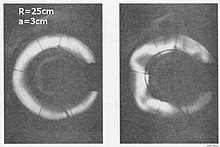
This instability is essentially plasma that has been warped out of shape. You can imagine this phenomenon with the example of a rubber band. If you twist a rubber band beyond its limit, it will form a second round of 'bumps'. Though it is possible for the kinked magnetic field to reconnect and stabilize, it simply does more harm than good in a Fusion Reactor.
Design
The goal of any torus-based Fusion Reactor is to use magnetic confinement to keep the hot plasma particles in the central region. Doing otherwise will cause the particles to rapidly cool, hence wasting energy. The problem with a torus, however, is that due to geometrical reasons, the particles will inevitably hit the outer wall of the torus (escaping the central region). The Tokamak's design sought to control the loss of the plasma 'pinch.' Other designs had magnetic fields that were too 'twisty', causing particles to step in and out of the pinch. The image below displays the magnetic fields in a Tokamak.
The Kink Instability is addressed in the Tokamak from the centrifugal force (of the plasma) which gives a stable density (or entropy) distribution within each magnetic surface. This enables the Tokamak to reach higher temperatures while remaining relatively safe.


Cool stuff!
ReplyDelete